Eco One batch reads about pH 7 or loses strength? Check the manual's vinegar step, cycles, water and storage to reach pH 5–6, then retest with the strips.
An Eco One batch made without the manual's vinegar step may read closer to pH 7. The manual adds 1 tsp of 5% distilled vinegar for a 200 ppm batch, or 2 tsp for 500 ppm, to reach pH 5–6. Check pH with the included strips. If strength drops later, check the container, then retest.
By HOCL LLC. This guide follows the Eco One manual, revision 2026-11-17. Checked November 20, 2026.
What is the correct Eco One recipe for a 1 liter batch?
Most "reads pH 7" and "fades fast" reports trace back to the recipe, the water or the storage. Compare what you did with the manual's steps for the Eco One hypochlorous acid generator:
- Add tap water (or purified water) up to the 1 liter mark. The pitcher holds 1.5 L, but the recipe is for 1 L: fill to the 1 L line molded on the pitcher (about mid-height), not to the top.
- Add 2 grams of non-iodized food-grade salt. The box includes a 1-gram measuring spoon.
- For 200 ppm, add 1 tsp of 5% distilled vinegar, giving pH 5–6. For 500 ppm, add 2 tsp of 5% distilled vinegar to the pitcher, keeping pH 5–6.
- Replace the lid and connect the power supply. The power supply connector must be dry.
- Power on. Setting 3 runs 8 minutes per cycle: run 2 cycles (16 minutes) for 200 ppm, or 5 cycles (40 minutes) for 500 ppm.
The manual notes that ppm values are approximations, because water quality varies.
Why does my Eco One batch read about pH 7?
1. Did I add the vinegar?
The manual says adding vinegar lowers the pH so that hypochlorous acid (HOCl) is the dominant free chlorine molecule. A batch made without the vinegar step may read closer to pH 7. Check that you added 1 tsp (200 ppm) or 2 tsp (500 ppm) of distilled vinegar labeled 5%.
2. Did I run the right mode?
The Eco One has a second mode that uses potassium carbonate instead of salt. That mode makes an alkaline degreaser, not HOCl, so its pH reads high by design. Potassium carbonate is sold separately ($9.99 add-on), and the manual says to use only the potassium carbonate additive for it. Don't combine salt and potassium carbonate: that neutralizes both. If you ran the degreaser mode by mistake, rinse the pitcher with tap water and start a new HOCl batch.
3. Am I reading the right strip?
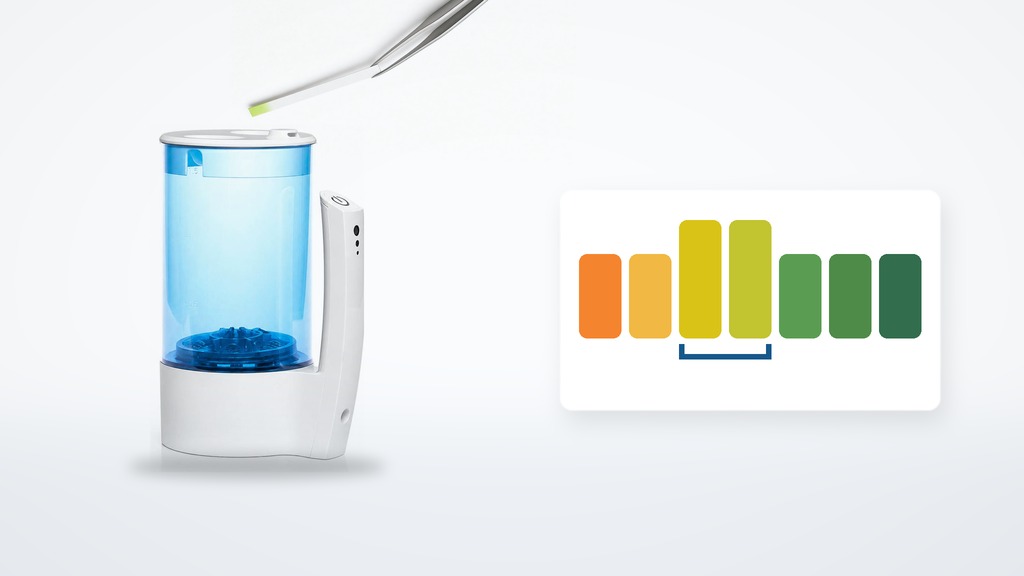
Measure pH with the pH strips and strength with the HOCl strips. They are different strips, and a strength reading doesn't tell you the pH.
4. Should I start a fresh batch?
The manual doesn't describe adjusting a finished batch. If the pH is outside 5–6, empty the pitcher, rinse it with tap water and make a new batch with the recipe above.
Why does my Eco One batch fade so fast?
1. Did I test right after the run?
Test strength and pH as soon as the cycles finish. A correct reading now suggests the machine and recipe worked, so a drop later points to storage. A low reading now points back to the recipe, the cycles or the water.
2. Did I run enough cycles for the strength I want?
200 ppm needs 2 cycles of Setting 3 (16 minutes). 500 ppm needs 5 cycles (40 minutes). Chlorine strips read 10–200 ppm. For a 500 ppm batch, mix 1 part solution with 4 parts water (a 1:5 dilution), read the diluted sample and multiply by 5. Example: a 100 ppm reading means 500 ppm.
3. Is my water a factor?
The manual recommends water hardness under 80 ppm. Use normal tap water or purified water. The store page adds that distilled or purified water may be used when helpful for water quality or storage.
4. How should I store a batch?
Manufacturer-stated storage: keeps close to 90% of its strength for about 90 days in a closed, light-protected container at room temperature or cooler. Use a closed, light-protected container, keep it at room temperature or cooler, and test again before use. Our guide to storage, containers and testing has more.
How do I read my pH and strength results?
| What you see | What to check |
|---|---|
| pH near 7 or higher | Vinegar step (1 tsp for 200 ppm, 2 tsp for 500 ppm, 5% distilled); degreaser mode not used by mistake |
| Strength lower than expected right after the run | Fill line (1 L), 2 g of non-iodized food-grade salt, number of cycles, water hardness under 80 ppm |
| Right after the run, then lower days later | Closed, light-protected container; room temperature or cooler; test again before use |
| Strip tops out at 200 ppm | Dilute 1:5 (1 part solution, 4 parts water) and multiply the reading by 5 |
For help reading strips, see how to test generated HOCl and what FAC, ppm and pH readings mean.
What should I avoid when making a batch?
- Never mix the solution with ammonia, bleach, strong acids or other cleaners. If someone breathes in fumes or swallows the solution, call Poison Help at 1-800-222-1222.
- Add only the ingredients and amounts the manual lists.
- Don't judge strength by smell or by pH alone. Use the HOCl strips.
What if my Eco One batch still tests wrong?
Email service@hocl.com with your water type, the mode and number of cycles you ran, and your HOCl and pH strip readings. If you are still deciding on a machine, the Eco One product page lists the recipe, timings and what's in the box. Our Eco One specs and box contents guide puts them in one place. Replacement test paper is sold at the store: HOCl test paper and pH test paper.
See the Eco One hypochlorous acid generator
Related reading
- Does HOCl expire? Eco One storage, containers and testing
- How to test generated HOCl: FAC and pH checklist
- FAC, ppm, pH and ORP: what generated HOCl measurements mean
- Eco One vs capsule generators: what a liter costs
- Eco One specs, box contents and how to check output
FAQ
Why does my Eco One batch read about pH 7?
A batch made without the manual's vinegar step may read closer to pH 7. The Eco One manual adds 1 tsp of 5% distilled vinegar for a 200 ppm batch, or 2 tsp for a 500 ppm batch, to bring the pH to 5–6. Check with the included pH strips.
What pH should an Eco One batch be?
The manual's target is pH 5–6, which is why the manual includes the vinegar step.
How long does an Eco One batch keep its strength?
Manufacturer-stated storage: keeps close to 90% of its strength for about 90 days in a closed, light-protected container at room temperature or cooler. If a stored batch tests low sooner, check the container, the recipe and your water, and email service@hocl.com.
Can I use the potassium carbonate with the salt?
No. Salt makes hypochlorous acid (HOCl) and potassium carbonate makes an alkaline degreaser (KOH), and combining them neutralizes both. Potassium carbonate is sold separately as a $9.99 add-on.
What should I send you if my batch still tests wrong?
Email service@hocl.com with your water type, the mode and number of cycles you ran, and your HOCl and pH strip readings. That tells us what to check first.