Made where you use it.
You make it from salt and water with your machine, so there's no drum of concentrate to ship or store. Your model's manual lists the salt type and water to use.
Hypochlorous acid (HOCl) is a weak acid that forms when chlorine dissolves in water. Its chemical formula is HOCl. (Wikipedia: Hypochlorous acid; PubChem CID 24341)
Hypochlorous acid is a much stronger oxidant than hypochlorite, the main form of chlorine in household bleach, and it's the same oxidant white blood cells make.
White blood cells make it too. See HOCl in the body.
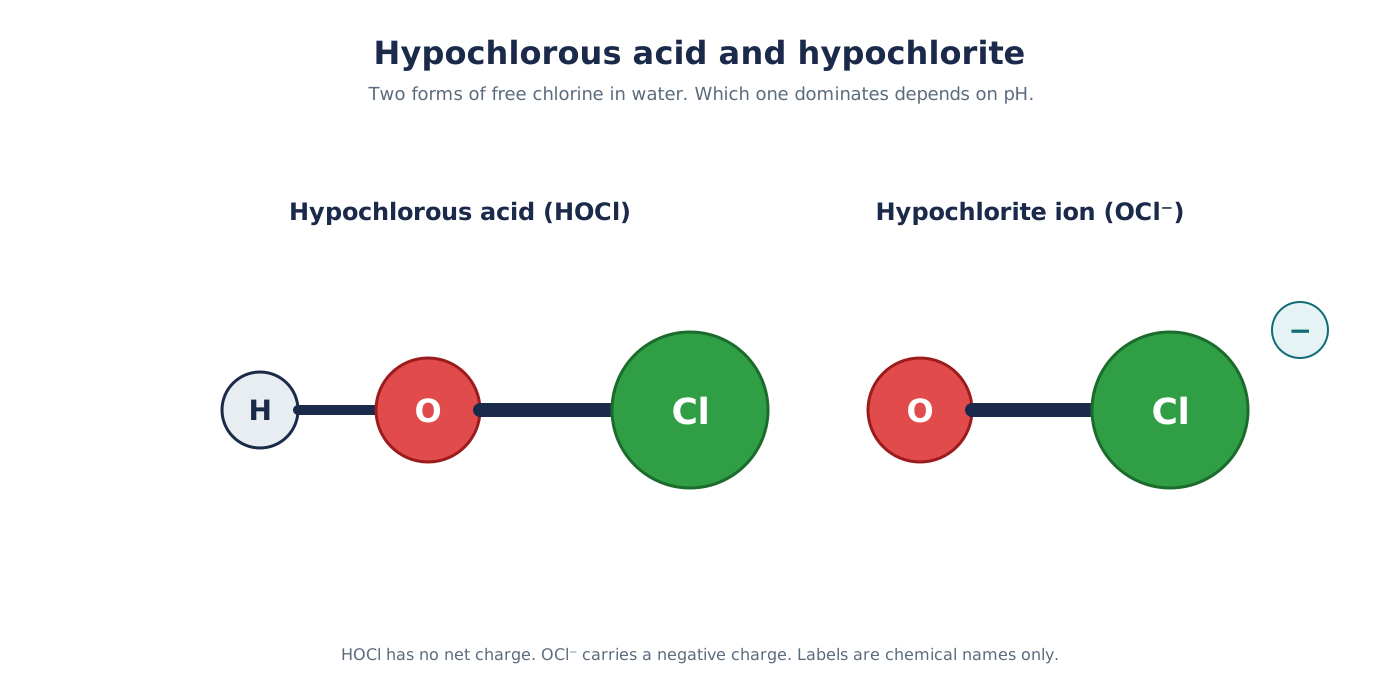
Your white blood cells make hypochlorous acid. Neutrophils, a type of white blood cell, carry an enzyme called myeloperoxidase. During a burst of extra oxygen use known as the "respiratory burst," myeloperoxidase uses hydrogen peroxide to turn chloride into HOCl:
Researchers showed this enzyme reaction in 1976. (Harrison & Schultz, J Biol Chem, 1976 (PubMed 176150); Klebanoff, "Myeloperoxidase: friend and foe," J Leukoc Biol, 2005 (PubMed 15689384); Wikipedia: Myeloperoxidase)
It's the same molecule a hypochlorous acid generator makes from salt water by electrolysis. Our machines make HOCl solution for cleaning, not for use in or on the body.
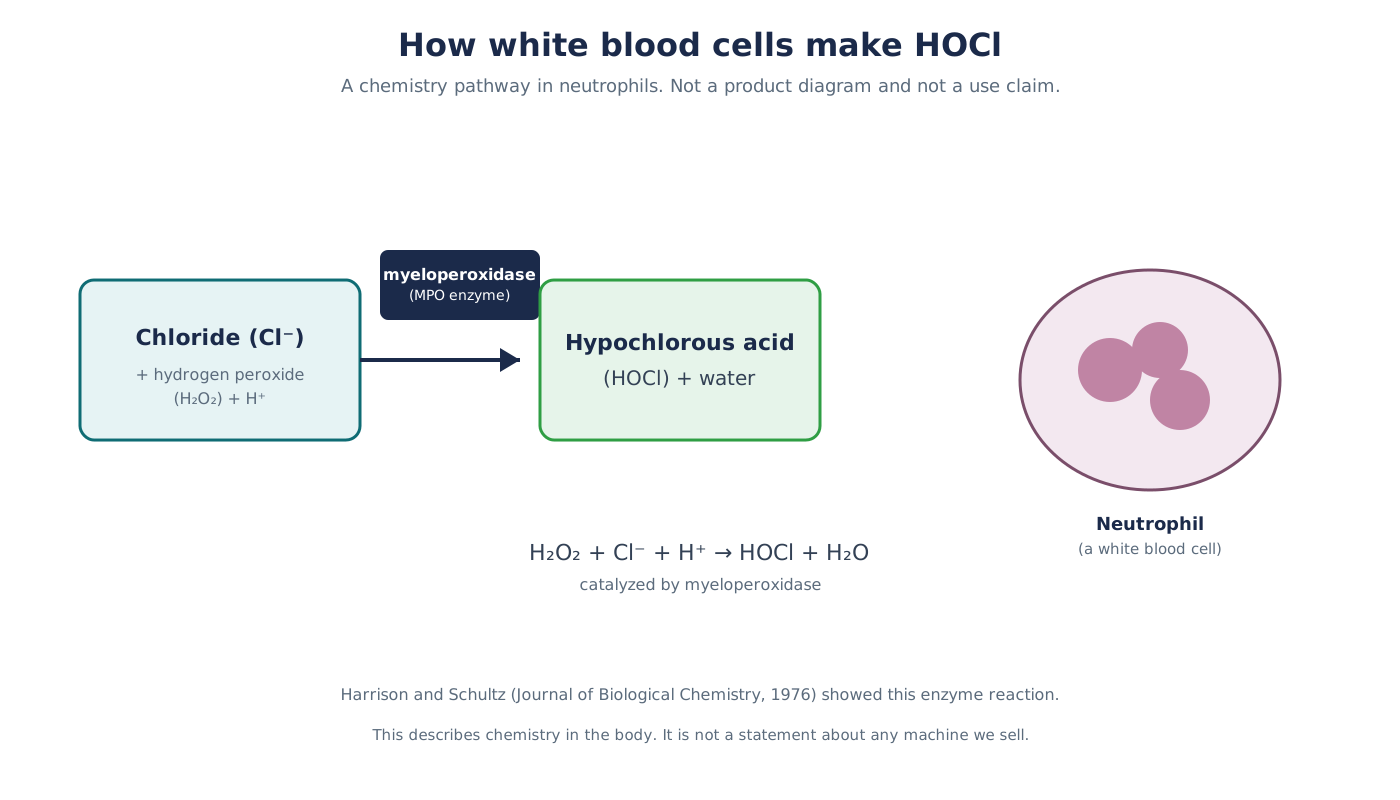
A hypochlorous acid generator, or HOCl machine, uses electrolysis. Inside an electrolysis cell, a direct electric current runs through salt water (sodium chloride and water). At the positive electrode (the anode), chloride turns into free chlorine, which forms hypochlorous acid and hypochlorite in the water. (Wikipedia: Electrolysis; Wikipedia: Chloralkali process)
What goes in is simple: salt, water and electricity. Some settings also call for a small pH additive. Each machine's manual lists the exact recipe, so follow the manual for your model. For more on the cell itself, see how an HOCl generator works.
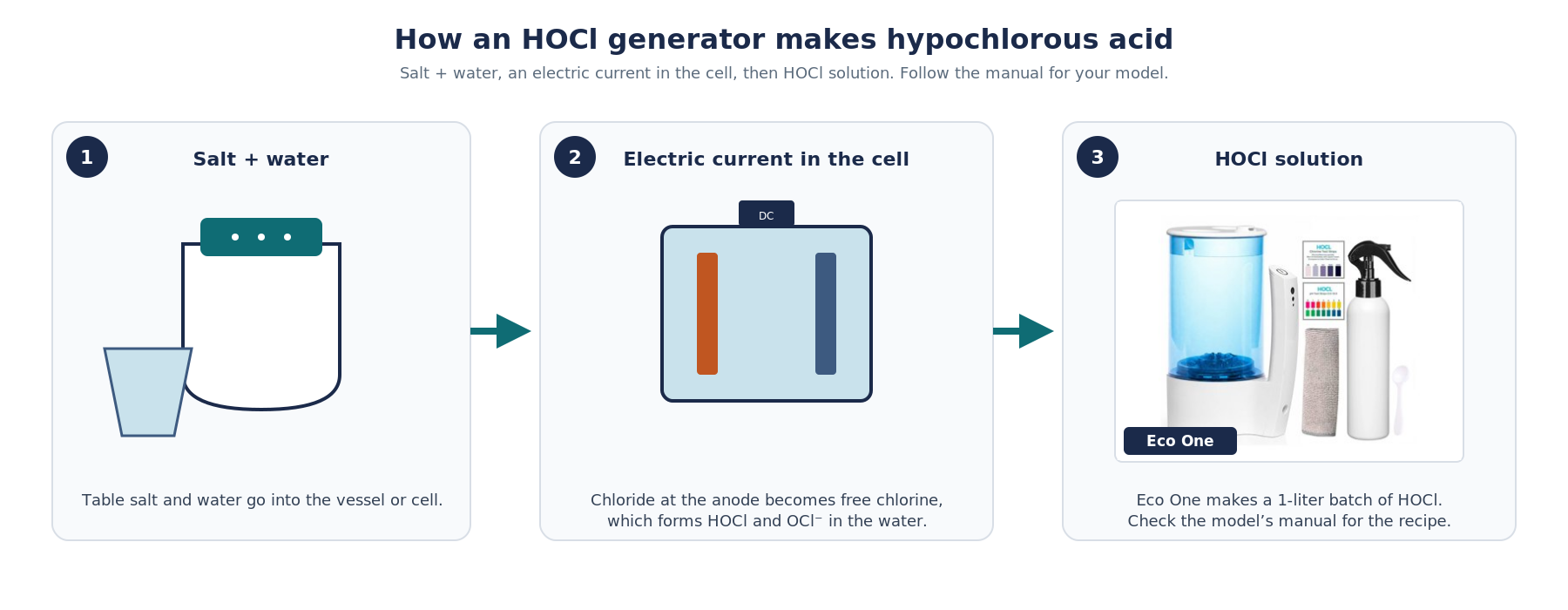
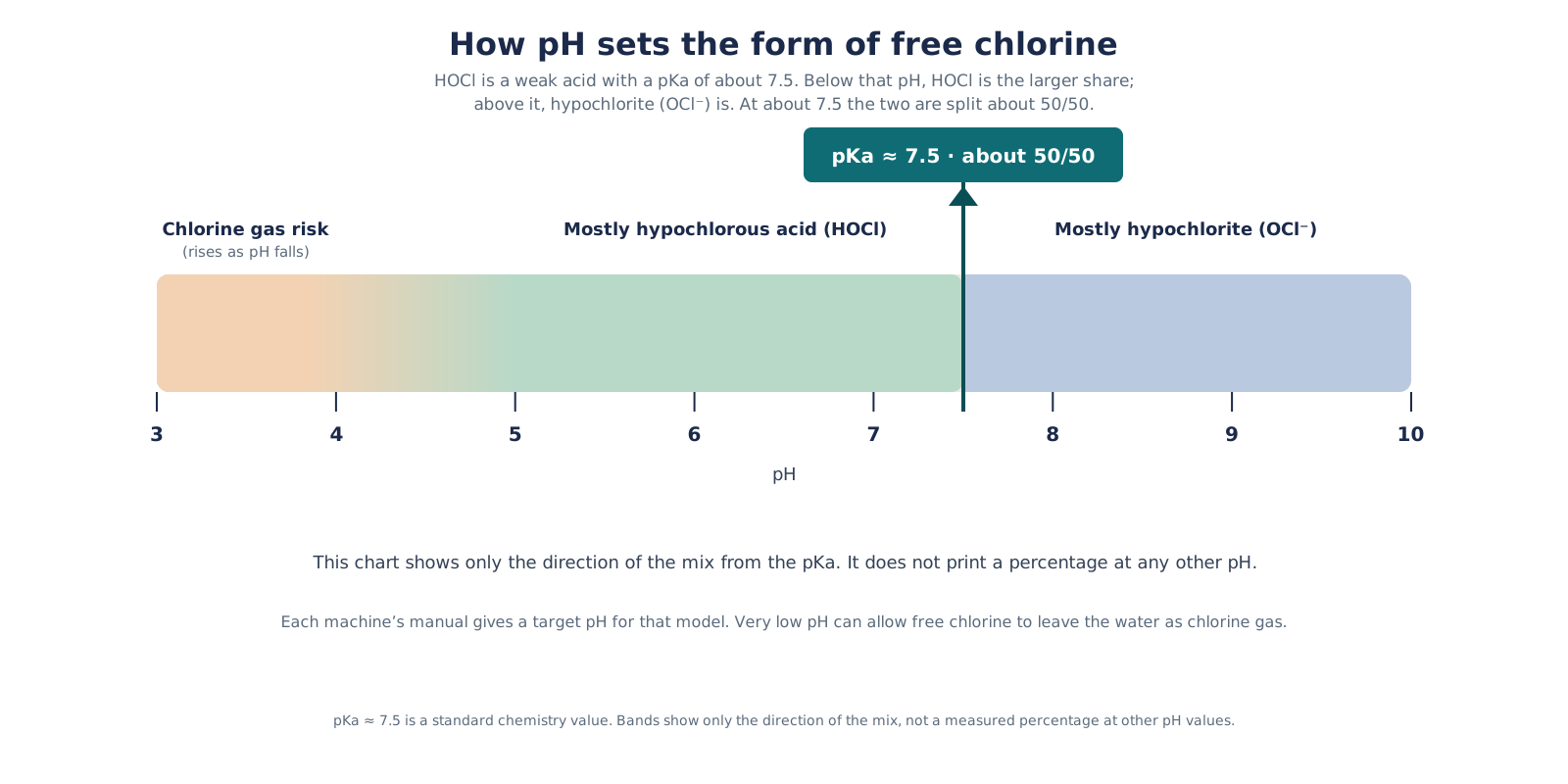
HOCl and hypochlorite are two forms of the same free chlorine, and the pH of the water decides how much of each you get. HOCl's pKa is about 7.5, so at that pH the two are split about 50/50. Below it, HOCl is the larger share. Above it, hypochlorite takes over. (Wikipedia: Hypochlorous acid, pKa 7.53)
Very low pH has its own problem: free chlorine can leave the water as chlorine gas. That's why the machines are designed to run in a mildly acidic to near-neutral range, and why each manual gives a target pH. The full chemistry is on our HOCl chemistry page.
You make it from salt and water with your machine, so there's no drum of concentrate to ship or store. Your model's manual lists the salt type and water to use.

Make what you need. HOCl slowly loses strength over time. For the Eco One portable HOCl machine, the manual states: "Manufacturer-stated storage: keeps close to 90% of its strength for about 90 days in a closed, light-protected container at room temperature or cooler." (Eco One manual, rev 2026-11-10)
Before you use it on fabric or a finished surface, test a small area you can't see.
Pick a machine by how much you need:
See the side-by-side table on how an HOCl generator works.
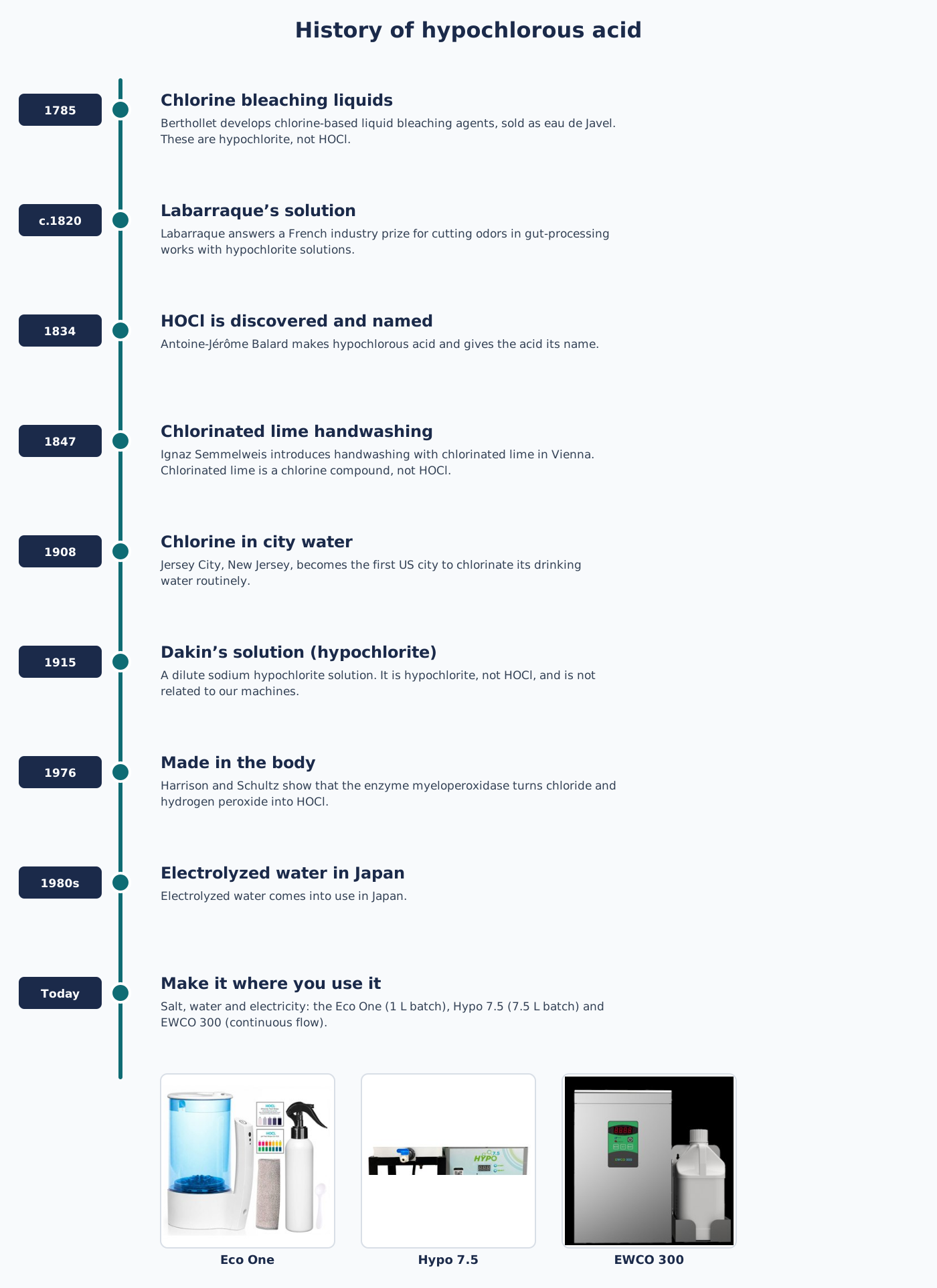
Claude-Louis Berthollet developed chlorine-based liquid bleaching agents, and the Javel works sold one as "liqueur de Javel" (eau de Javel). (University of Bristol, Molecule of the Month: Bleach)
Berthollet published his bleaching method in Annales de Chimie. He noted that the Javel makers had added alkali to make their "lessive de Javelle." (Revue d'histoire de la pharmacie, 1933)
A French industry society offered a prize for cutting odors in gut-processing works. Antoine-Germain Labarraque answered with hypochlorite solutions, later called "Labarraque's solution." (McGill Office for Science and Society)
The French chemist Antoine-Jérôme Balard made hypochlorous acid by adding mercury(II) oxide in water to chlorine gas, and he named the acid. (Wikipedia: Hypochlorous acid)
At Vienna General Hospital, Ignaz Semmelweis had doctors and medical students wash their hands with chlorinated lime, a chlorine compound, not HOCl. (Science History Institute: Ignaz Semmelweis)
Jersey City, New Jersey, became the first US city to use chlorine routinely to treat its municipal drinking water. (US EPA archive: The History of Drinking Water Treatment)
During World War I, the chemist Henry D. Dakin published the formula that became Dakin's solution. That solution was dilute sodium hypochlorite, not hypochlorous acid, and it isn't related to our machines. (Dakin, BMJ, Aug 28, 1915)
(See HOCl in the body.) Harrison and Schultz showed that myeloperoxidase, an enzyme in white blood cells, converts chloride and hydrogen peroxide into HOCl. (J Biol Chem, 1976 (PubMed 176150))
In Tashkent, in the USSR, a research group began work on electrochemical treatment of water and introduced the term "electrochemical activation" (ECA). A divided cell makes an acidic anolyte and an alkaline catholyte. (V. M. Bakhir institute chronology; Univ. of Pretoria thesis, ch. 1)
Electrolyzed water came into use in Japan. (USDA AMS Technical Report: Hypochlorous Acid, Aug 13, 2015)
Understanding pH. HOCl is a weak acid with a pKa of about 7.5. That's why pH decides whether a chlorine solution is mostly HOCl or mostly hypochlorite. (Wikipedia: Hypochlorous acid)
Never mix HOCl solution with bleach, ammonia or strong acids. If someone swallows it or gets it in their eyes, call Poison Help at 1-800-222-1222.
A standard reference on chlorine chemistry is White's Handbook of Chlorination and Alternative Disinfectants (Wiley). (Wiley book page, DOI 10.1002/9780470561331)
You can also browse published studies in our hypochlorous acid research library. Those studies describe the conditions their authors tested. They aren't product claims for any machine we sell.
Shop
From a countertop machine to commercial-grade systems.
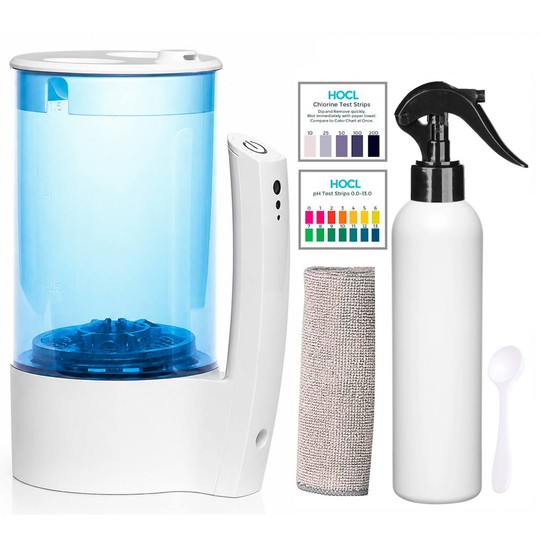
Makes a 1-liter batch of hypochlorous acid at home from salt and water.
$199.99 + free shipping
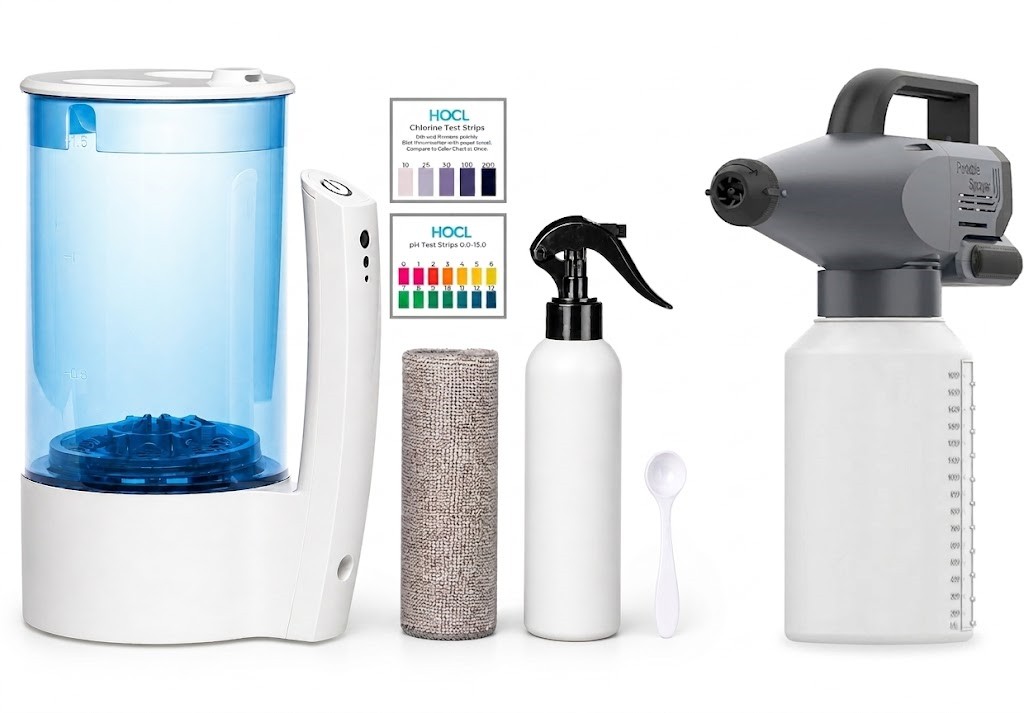
Make hypochlorous acid and spray with an electrostatic cold fogger.
$349.99 + free shipping
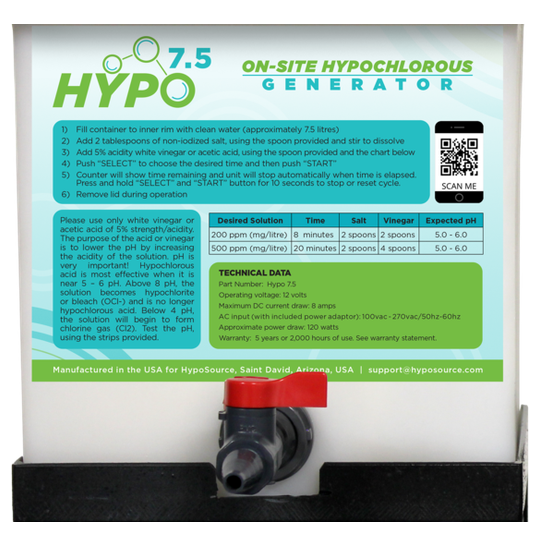
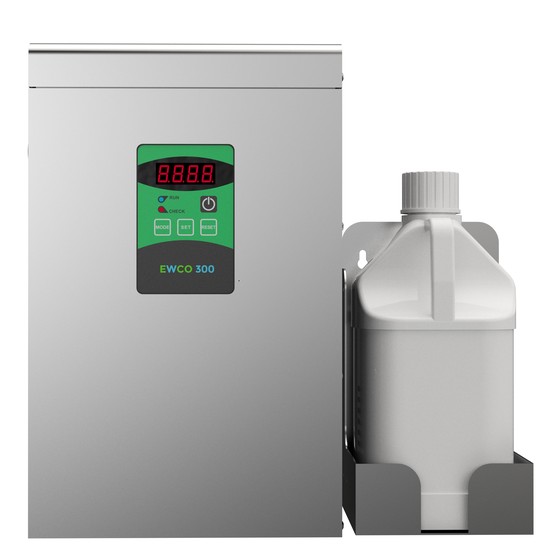
Commercial-grade HOCl machines: continuous-flow EWCO generators for facilities.
$4,999.00
Questions about HOCl or our machines: email service@hocl.com.
Spotted an error on this page? Email corrections@hocl.com with the page URL and the correction.