FAC, ppm, pH and ORP each answer a different question about generated HOCl. See how the Eco One, Hypo 7.5 and EWCO 300 manuals describe them.
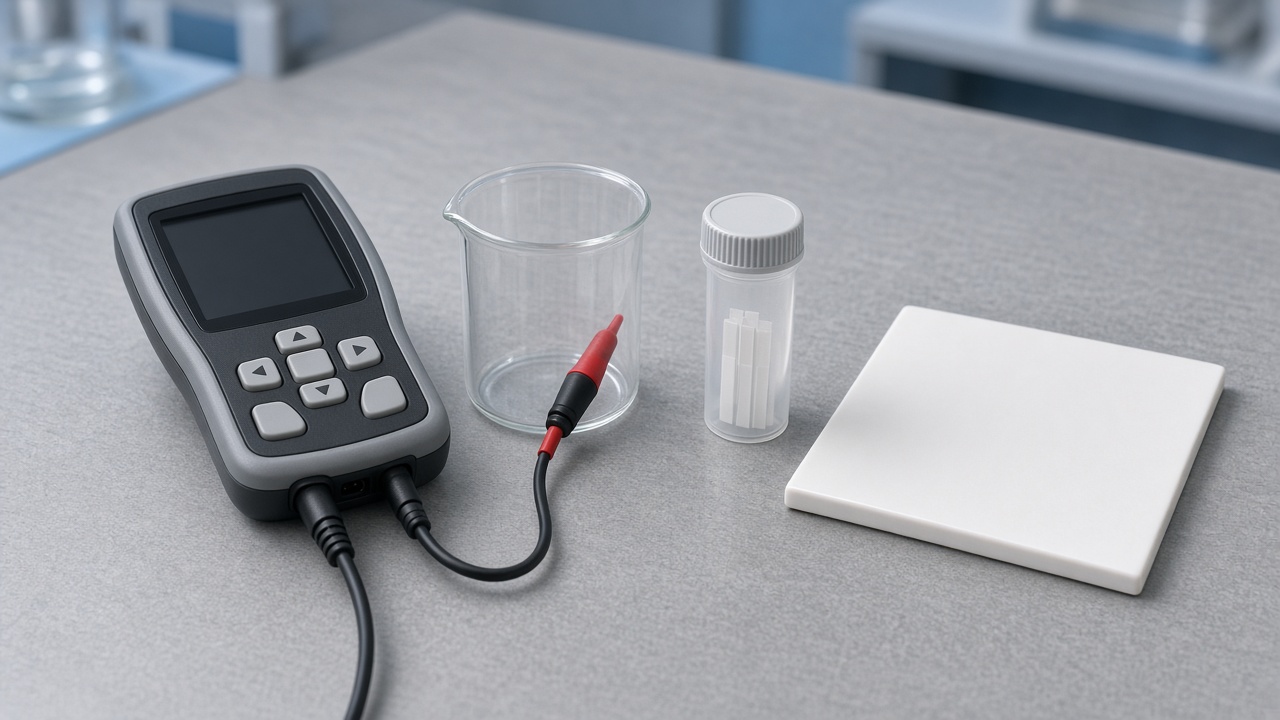
The short answer
- FAC is how much free chlorine is in the solution.
- ppm is the unit usually used to express FAC.
- pH tells you which form that chlorine is mostly in.
- ORP (oxidation-reduction potential) is a millivolt reading that manufacturers list for their solutions.
Each answers a different question. None, on its own, proves a solution will meet the directions for a cleaning use. That depends on the product's directions, including concentration, contact time, and precleaning.
Free available chlorine (FAC)
Free available chlorine includes hypochlorous acid (HOCl), hypochlorite ion (OCl⁻), and elemental chlorine (Cl₂). The Eco One manual notes that HOCl is a free chlorine molecule that can be measured with chlorine test paper.
FAC is the measurement most directly tied to strength.
How to measure: free-chlorine test strips or a chlorine photometer. The EWCO 300 manual refers to spot-checking FAC with test strips or a photometer.
ppm (parts per million)
ppm is the concentration unit used throughout the manuals and sources reviewed here. For comparison, household bleach at 5.25%–6.15% sodium hypochlorite is 52,500–61,500 ppm available chlorine.
A ppm number only means something with context: the product, the use, and the directions. Higher isn't automatically better. Use the concentration your label or manual specifies.
Generator ppm figures are approximate. The Eco One manual notes measurements vary with water quality, and the EWCO 300 manual says its concentration charts are a guide that varies with additive, pump speed, and water quality. The Eco One makes up to 500 ppm; the Hypo 7.5 is specified at 200 or 500 ppm; the EWCO 300 makes up to 300 ppm.
pH
pH measures acidity. In chlorine solutions, it determines the balance between HOCl and OCl⁻. As pH rises, the balance shifts from HOCl toward hypochlorite ion.
Manufacturer manuals describe target ranges:
- The Eco One manual and product page give pH 5–6 for a batch made with the specified vinegar step (1 tsp of 5% distilled vinegar for 200 ppm, 2 tsp for 500 ppm).
- The Hypo 7.5 manual says to verify the pH is between 5 and 6.
- The EWCO 300 manual lists approximate pH by additive formula, from about 7–8 (food-grade salt and water) to about 5–6 (with acid).
The EWCO 300 manual also cautions that free chlorine can form chlorine gas when a solution becomes acidic. Adjust pH only with the ingredients and amounts your manual specifies. Never mix HOCl solution with ammonia, bleach, strong acids or other cleaners; doing so can release toxic chlorine gas. If someone breathes in fumes or swallows solution, call Poison Help at 1-800-222-1222 (poisonhelp.hrsa.gov).
What pH doesn't tell you: how much chlorine is present. A solution can have the "right" pH and very little FAC.
ORP (oxidation-reduction potential)
ORP is reported in millivolts (mV). The Eco One product page lists +800 to +1000 mV (the manual ties this to Setting 3), and the EWCO 300 manual and product page give ranges too.
What ORP doesn't tell you: ORP isn't a concentration reading, and the sources reviewed for this article don't establish ORP alone as proof that a solution is effective for a given use. Use an FAC test for strength.
Smell
Smell isn't a measurement. It doesn't tell you concentration, pH, or whether directions for a use will be met.
How the readings fit together
| Question | Measurement | Tool |
|---|---|---|
| How much free chlorine is there? | FAC, in ppm | Chlorine test strips or photometer |
| Which form is the chlorine mostly in? | pH | pH strips or meter |
| What ORP does the manufacturer list? | ORP, in mV | ORP meter |
| Does it match my use directions? | None alone | Follow the label or manual: concentration, precleaning, contact time |
For any cleaning use, clean the surface first and follow the product's directions, including contact time.
To test a batch, use the HOCl test paper and pH test paper sold for these machines, and see How to Test Generated HOCl: FAC and pH Checklist.
Related
- How to Test Generated HOCl: FAC and pH Checklist
- Does HOCl Expire? Eco One Storage, Containers and Testing
- HOCl vs. Bleach: Chemistry, pH and Real-World Use Differences
- Eco One · Hypo 7.5 · EWCO 300
General information only. Always follow your product's label or manual.