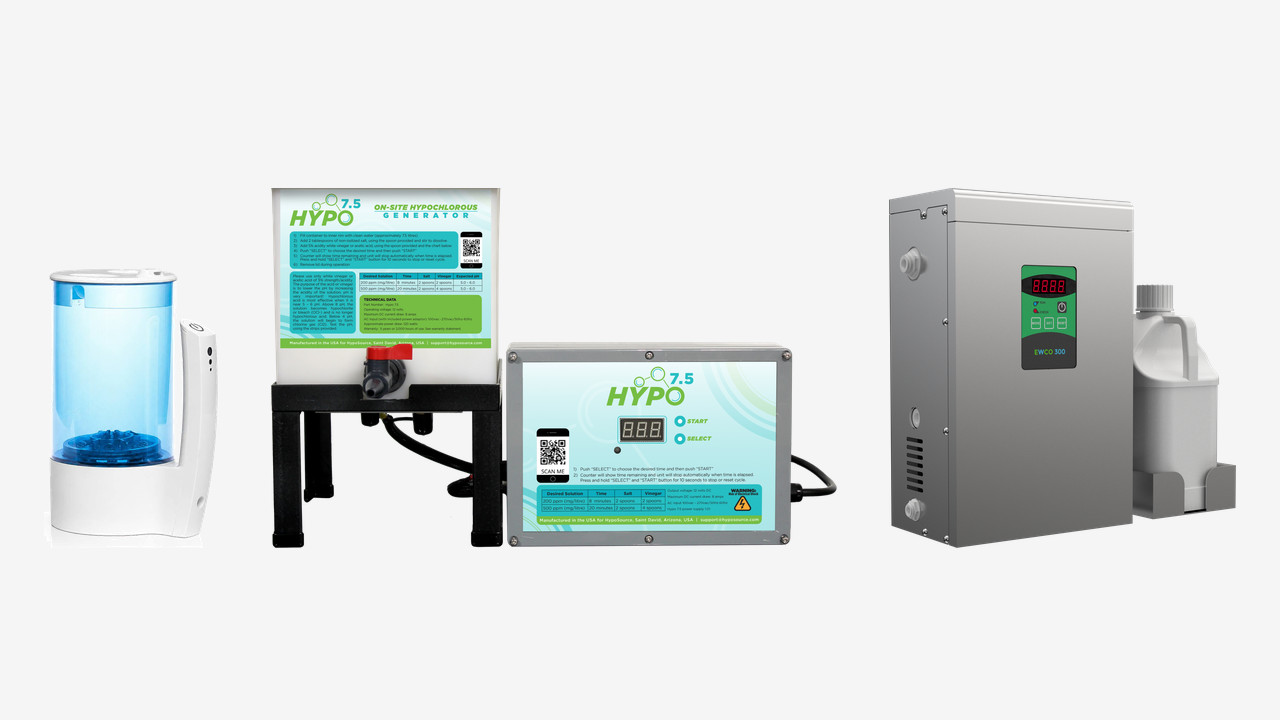
Side-by-side comparison of the Eco One, Hypo 7.5 and EWCO 300 hypochlorous acid generators: output at stated conditions, inputs, testing, installation, maintenance, warranty and price.
The short answer
- Eco One: for homes and small spaces making about a liter at a time.
- Hypo 7.5: for larger batches (7.5 liters) without plumbing; its manual says it is designed for commercial use.
- EWCO 300: for facilities that need continuous, plumbed production and can meet its installation and feedwater requirements.
All figures below are manufacturer statements, with the conditions each source gives. Concentrations are approximate.
Output at a common concentration: 200 ppm
Comparing at one stated concentration avoids mixing up maximum volume and maximum strength.
| Model | Stated 200 ppm output | Conditions | Source |
|---|---|---|---|
| Eco One | 1 liter in 16 minutes | 1 L fill, 2 g salt; Setting 3 run twice | Manual, product page |
| Hypo 7.5 | 7.5 liters in 8 minutes | 2 gal water, 2 scoops salt; 5% vinegar: 2 scoops for the 200 ppm cycle or 4 scoops for the 500 ppm cycle | Manual |
| EWCO 300 | 1.5 L/min continuous | Formula 1 (salt + water) at 22 A and minimum flow | Manual |
Batch times exclude filling, testing, decanting, and rinsing. EWCO 300 output falls as flow rises; at 3.0 L/min the same formula and amperage give about 100 ppm.
Maximum stated concentration (and what it costs in volume)
| Model | Highest stated | At what conditions |
|---|---|---|
| Eco One | 500 ppm | 1 L in 40 minutes, with 2 tsp 5% vinegar added before the cycle for pH 5–6 (Eco One manual) |
| Hypo 7.5 | 500 ppm per cycle | 7.5 L; 20 minutes for 500 ppm |
| EWCO 300 | 300 ppm | Formula 3 (salt + water + HCl), 22 A, 1.5 L/min minimum flow only |
Side-by-side
| Eco One | Hypo 7.5 | EWCO 300 | |
|---|---|---|---|
| Type | Portable batch | Batch, tank on stand | Continuous flow, wall-mounted |
| Volume | 1 L per batch | 7.5 L (2 gal) per batch | 1.5–6.0 L/min (charted range) |
| Stated concentrations | 40, 60, 100, 200 ppm (manual); 500 ppm (product page and Eco One manual) | 200 or 500 ppm (manual) | 20–300 ppm FAC (manual and product page) |
| Stated pH | pH 5–6 with the manufacturer's vinegar step at 200 or 500 ppm (Eco One manual); manual: HOCl most dominant at pH 4–6 | 5–6 (manual) | ≈7–8, 6–7, or 5–6 depending on formula (manual) |
| Inputs | Water, 2 g non-iodized salt/L, vinegar (1 tsp for 200 ppm; 2 tsp 5% for 500 ppm, per the Eco One manual) | Water, table salt (iodized or non-iodized), 5% vinegar | Feedwater plus brine additive: salt, salt + vinegar, or salt + HCl |
| Power | 110V/220V | 120–240 VAC @ 1.7 A, 50/60 Hz; 12 V DC input; about 120 W (product page) | AC 110/220 V, 180 W |
| Installation | Countertop, plug in | No plumbing; well-ventilated area required (manual) | Wall mount, plumbed inlet/outlet, ventilated area, qualified installer |
| Feedwater limits | Tap or purified water; recommended hardness < 80 ppm (Eco One manual) | Clean water; monthly check for calcium buildup from hard water | Hardness < 80 ppm; 10–30 °C; ≥1.5 L/min; ≤87 PSI |
| Routine maintenance | Rinse pitcher with tap water after use | Daily leak/wire checks; monthly calcium check and acid wash if needed; rinse after use | Additive refills, hose length, flow, settings, alarm checks, filter replacement |
| Included testing | pH test strips and HOCl test paper (10–200 ppm) come free with every Eco One order; refills are sold separately (HOCl test paper, pH test paper). | HOCl test strips (product page) | Chlorine and pH test paper (product page) |
| Operator | Not for use by children | Not for children or anyone not capable; qualified technician for service | Trained, designated responsible person |
| Cell life (stated) | Not stated in current sources | 4,000 hours expected cell life (data sheet) | Not stated in sources reviewed |
| Manufacturer-stated storage | Keeps close to 90% of its strength for about 90 days in a closed, light-protected container at room temperature or cooler; test before use. | Not stated | Not stated |
| Warranty | 1-year limited, household use | See terms and conditions | 1-year limited (HOCL LLC); wear parts excluded |
| Listed price (Nov 7, 2026) | US $199.99 | US $2,199.00 | US $4,999.00 |
Choosing by situation
You need spray-bottle quantities at home. The Eco One makes 1 liter at a time and plugs in on a counter. Every order comes with a fine-mist sprayer, HOCl test paper and pH test paper free, and the product page lists a potassium carbonate sample for its separate degreasing mode.
You need several gallons at a time without plumbing. The Hypo 7.5 makes 7.5 liters per cycle and drains through a valve and fill tube. Its manual requires a well-ventilated area, warns that the system can release high doses of chlorine, and says not to stir with a metal spoon. Plan for monthly calcium checks if your water is hard.
You need a steady supply throughout the day. The EWCO 300 produces as water flows, and can feed a holding tank with a float sensor (Level mode). It needs a ventilated wall location, feedwater below 80 ppm hardness, sustained flow of at least 1.5 L/min, a qualified installer, and a trained operator. Size it at the concentration you need: doubling flow from 1.5 to 3.0 L/min roughly halves concentration in the manual's charts.
What to test, whichever you choose
Every Eco One order comes with HOCl test paper (10–200 ppm) and pH test paper free. Per their product pages, the EWCO 300 lists chlorine and pH test paper in the box, and the Hypo 7.5 lists HOCl test strips in the box. Test each batch, or spot-check continuous output against the manual's charts. Readings are approximate and don't, on their own, show that a surface has been sanitized or disinfected.
Ingredients and mixing
Use only the ingredients and amounts each manual specifies, such as Eco One's optional vinegar step, Hypo 7.5's vinegar scoops, or EWCO 300's additive formulas. Never mix HOCl solution with ammonia, bleach, strong acids or other cleaners; doing so can release toxic chlorine gas. Add only the vinegar or additive your manual specifies, in the amount it specifies. If someone breathes in fumes or swallows solution, call Poison Help at 1-800-222-1222 (poisonhelp.hrsa.gov). The CDC says not to mix products or chemicals with each other.
A note on regulation
The EPA generally treats hypochlorous acid generators as devices, and notes that sale or distribution with a substance, or use in a service, can change how a generator is treated. This page makes no registration, establishment-number, or compliance claim for any model. The EPA recommends that electrolyzed water from these devices not be ingested or applied to the human body.
Next steps
Questions about fit? Email service@hocl.com. For commercial projects, visit ewco.com.
Sources (Eco One manual Rev 2026-11-10 accessed November 10, 2026; other sources accessed November 7, 2026)
- Eco One product page
- Eco One User Manual (PDF, Rev 2026-11-10)
- Hypo 7.5 product page
- Hypo 7.5 Product Manual (PDF, Hypo Source, dated 4/26/2021)
- Hypo 7.5 Data Sheet (PDF)
- EWCO 300 product page and warranty
- EWCO 300 User Manual (PDF)
- EPA: Pesticide Devices: A Guide for Consumers
- CDC: When and How to Clean and Disinfect Your Home