Eco One portable hypochlorous acid generator: what it makes, manual settings and stated output, how to test each batch, storage guidance, what's in the box, and owner FAQs.
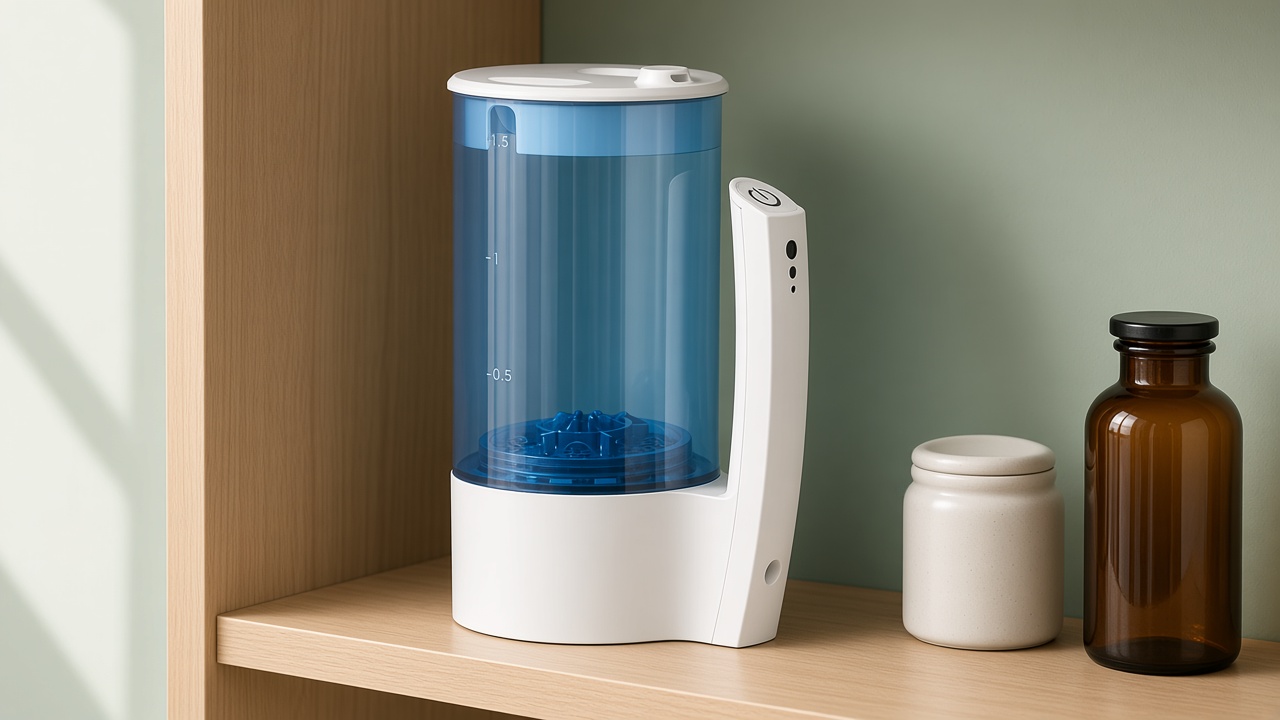
What it is
The Eco One (model E1) is a portable countertop generator that makes a 1-liter batch of hypochlorous acid (HOCl) from water and non-iodized salt in a platinum-coated titanium electrolysis cell, according to its product page. It runs on 110V or 220V, 50/60 Hz. Listed price on November 7, 2026: US $199.99.
It also has a separate cleaning/degreasing mode that uses food-grade potassium carbonate instead of salt (manual).
How to make a batch
From the Eco One manual:
- Add tap or purified water up to the 1-liter mark.
- Add 2 grams of food-grade, non-iodized salt (NaCl) with the included 1-gram spoon.
- Optional but recommended: add 1 teaspoon of 5% distilled white vinegar. The manual states this lowers pH so HOCl is the dominant free chlorine molecule. Per the Eco One manual: For 200 ppm, add 1 tsp 5% distilled vinegar, giving pH 5–6. For 500 ppm, add 2 tsp 5% distilled vinegar to the pitcher before the 40-minute cycle, keeping pH 5–6.
- Replace the lid, connect the power supply (the connector must be dry), and power on.
Use only these manufacturer-specified ingredients. Never mix HOCl solution with ammonia, bleach, strong acids or other cleaners; doing so can release toxic chlorine gas. Add only the vinegar or additive your manual specifies, in the amount it specifies. If someone breathes in fumes or swallows solution, call Poison Help at 1-800-222-1222 (poisonhelp.hrsa.gov).
Degreasing mode: 1 liter of water plus 2 grams of potassium carbonate, run on Setting 3 for 8 minutes, per the manual. Don't combine salt and potassium carbonate in one batch; the product page says doing so neutralizes both.
Output: settings and stated concentrations
Concentrations are approximate. The manual notes they vary with water quality.
Manual settings (1-liter fill, salt batch):
| Setting | Run time | Stated approx. concentration |
|---|---|---|
| Setting 1 | 3 minutes | 40 ppm |
| Setting 2 | 5 minutes | 60 ppm |
| Setting 3 | 8 minutes | 100 ppm |
| Setting 3, run twice | 16 minutes | 200 ppm |
Product page production table (1 liter): 40 ppm in 3 min, 60 ppm in 5 min, 100 ppm in 8 min, 200 ppm in 16 min, and 500 ppm in 40 min (product page). The vinegar step for 500 ppm comes from the Eco One manual. See "How to make a batch" above.
The product page lists ORP of +800 to +1000 mV; the manual attributes that range to Setting 3. ORP is a characteristic of the solution, not a measure of concentration or proof of effectiveness.
How to test each batch
- Concentration: Use free-chlorine test paper. The manual describes color matches at 10, 50, 100, and 200 ppm. The strips read up to 200 ppm. For a 500 ppm batch, mix 1 part solution with 4 parts water (a 1:5 dilution), test the diluted sample, and multiply the reading by 5 (a 100 ppm reading means about 500 ppm).
- pH: Use pH strips. Per the Eco One manual, the vinegar steps above give pH 5–6 for 200 ppm and 500 ppm batches. The manual also says HOCl is most dominant between pH 4 and 6.
- What testing tells you: Strips give an approximate concentration and pH reading. They don't show that a surface has been sanitized or disinfected, and pH or smell alone doesn't tell you concentration.
Storage
- The Eco One Safety Data Sheet says to store in a cool area away from UV or direct sunlight, with the container tightly closed when not in use.
- Test stored solution before use rather than assuming it has kept its strength.
- Store salt and potassium carbonate in a clean, dry location (manual).
Manufacturer-stated storage: keeps close to 90% of its strength for about 90 days in a closed, light-protected container at room temperature or cooler. It doesn't apply to other products. Test before use and confirm the concentration still meets your intended-use directions.
Precautions from the manual
- The appliance should not be used by children; take care when using it near children.
- Don't immerse the base or power supply in water, and don't put it in a dishwasher.
- Turn off before cleaning. Rinse only with tap water. Empty and rinse the pitcher after use.
- Use only the detachable power unit provided; don't operate with a damaged cord or plug.
- If the unit is damaged or leaks, disconnect it at the wall.
- Use only tap or purified water. Recommended feedwater hardness is less than 80 ppm, per the Eco One manual.
The EPA recommends that electrolyzed water generated by these devices not be ingested or applied to the human body.
What's in the box
Per the product page: Eco One electrolyzer, power adapter, 8 oz PET fine-mist sprayer, 1-gram measuring spoon, microfiber cloth, 100 g potassium carbonate sample, and user manual. Every Eco One order comes with HOCl test paper (10–200 ppm) and pH test paper free; refills are sold separately (HOCl test paper, pH test paper). Optional add-ons listed: potassium carbonate (100 g) and an electrostatic cold fogging sprayer.
Specifications
| Model | E1 |
| Cell | Titanium with platinum coating |
| Power | 110V/220V, 50/60 Hz |
| Dimensions | 21 × 15 × 36 cm (8.3 × 5.8 × 14 in) |
| Weight | 0.6 kg (1.3 lb) |
| Warranty | 1-year limited, for personal, family, or household use by U.S. consumers who bought from the HOCL Store |
Owner FAQs
What does the Eco One make? Hypochlorous acid from water and salt, or a separate potassium carbonate degreasing solution.
Do I need special capsules? No. Per the product page, it uses off-the-shelf non-iodized salt or potassium carbonate.
Can I use tap water? Yes. The manual recommends feedwater hardness under 80 ppm; the product page says distilled or purified water may be used when helpful for water quality or storage.
Is the vinegar required? The manual lists it as optional but recommended, to lower pH. Use only the amount the manual specifies.
Can I use iodized salt? The manual says to use food-grade salt and recommends pure salt without iodine.
How strong should I make it? Use the setting your intended use and directions call for. Follow the manual rather than improvising stronger batches.
How do I know it worked? Check concentration and pH with test strips. That confirms an approximate reading, not disinfection.
Can I use it on my skin, eyes, or pets? No. The EPA recommends generated electrolyzed water not be applied to the human body or ingested. This product page makes no skin, eye, pet, or plant treatment claims.
Is the Eco One EPA registered? The EPA generally treats HOCl generators as devices rather than registered products. An EPA Establishment Number, where shown, identifies a production facility and isn't a registration, approval, or endorsement.
Where can I get help? Email service@hocl.com.
Related
- What Is Hypochlorous Acid? (hocl.com/blog/what-is-hypochlorous-acid)
- How to Choose a Hypochlorous Acid Generator
- Eco One vs Hypo 7.5 vs EWCO 300